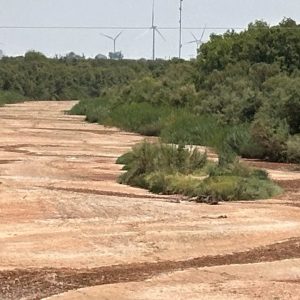
Vernon seeks 20% water-use reduction under Stage 2 drought measures
The City of Vernon is asking water customers to voluntarily reduce their use by 20% under Stage 2 conservation measures after reporting a static aquifer level of 37.82 feet.
Stage 2, classified as a moderate water shortage condition, is triggered when the static aquifer level reaches 38.5 feet or when low aquifer levels result in a 20% loss of maximum production capability, with pumping capacity falling to 6.6 million gallons per day for a 24-hour period.
The city’s reported 37.82-foot level is 0.32 feet, or about 3.8 inches, above the 37.5-foot threshold for Stage 3, when the city’s drought restrictions become mandatory.
Under Stage 2, customers are asked to follow a voluntary watering schedule. Odd-numbered addresses are asked to water only on Mondays and Wednesdays, while even-numbered addresses are asked to water only on Tuesdays and Thursdays. Customers are asked to limit landscape irrigation to those designated days between 8 p.m. and 10 a.m.
No new landscape irrigation taps will be made during Stage 2. The city manager or a designee also is directed to contact wholesale water customers and ask them to implement voluntary measures aimed at reducing water use by 20%.
Vernon depends entirely on groundwater from the Seymour Aquifer and operates five well fields. The city’s plan identifies 42 feet as the normal static aquifer level and lists the water system’s maximum pumping capacity at 8.3 million gallons per day.
The city manager or a designee monitors water supply and demand conditions daily and determines when conditions warrant beginning or ending each drought stage. The plan also allows the city to implement an appropriate drought-response stage during periods of high demand or distribution limitations.
Vernon’s five-stage drought plan becomes progressively more restrictive as aquifer levels decline.
Stage 1 — Mild water shortage
Stage 1 begins when the static aquifer level reaches 41 feet or low aquifer levels cause a 15% loss of maximum production capability, with pumping capacity falling to 7.1 million gallons per day for 24 hours. The target is a 15% reduction in total water use compared with the three-year average before the latest drought condition.
The Stage 1 watering schedule is voluntary. Odd-numbered addresses are asked to water Mondays, Wednesdays and Fridays, while even-numbered addresses are asked to water Tuesdays, Thursdays and Saturdays. Landscape irrigation is requested only between 8 p.m. and 10 a.m., with no Sunday watering. Customers also are asked to minimize or discontinue nonessential water use.
The city also curtails water-line flushing except when necessary to protect public health and limits watering of public areas to between 7 and 10 a.m. Wholesale customers are asked to reduce water use by 15%.
Stage 2 — Moderate water shortage
Stage 2 begins at a static aquifer level of 38.5 feet or when low aquifer levels result in a 20% loss of maximum production capability, with pumping capacity falling to 6.6 million gallons per day for 24 hours. The target is a 20% reduction in total water use.
The Stage 2 watering schedule remains voluntary, but watering is reduced to two days a week. Odd-numbered addresses are asked to water Mondays and Wednesdays and even-numbered addresses Tuesdays and Thursdays, between 8 p.m. and 10 a.m.
Stage 2 may be rescinded when the aquifer level increases back to Stage 1 or normal capacity and remains there for 45 days.
Stage 3 — Severe water shortage
Stage 3 begins when the static aquifer level reaches 37.5 feet or low aquifer levels result in a 25% loss of normal production capability, with pumping capacity falling to 6.2 million gallons per day for 24 hours. The target is a 25% reduction in total water use.
Unlike Stages 1 and 2, Stage 3 restrictions are mandatory. Odd-numbered addresses may water only Mondays and Wednesdays, while even-numbered addresses may water only Tuesdays and Thursdays. Landscape irrigation is limited to between 8 p.m. and 10 a.m.
Vehicle washing is limited to Tuesdays, Thursdays and Saturdays during those hours and must be done with a bucket or handheld hose equipped with a shut-off nozzle. Commercial car washes, detail shops and dealerships may request a variance. Charity car washes are prohibited. Exceptions apply when more frequent washing is necessary to protect public health, safety or welfare.
Filling or adding water to swimming pools, wading pools and Jacuzzi-type pools is allowed only on designated watering days between 8 p.m. and 10 a.m. Washing buildings or industrial equipment is prohibited, as is using water for ornamental fountains or water features.
Water may not be used to wash sidewalks, driveways, parking lots, streets, tennis courts, patios or other paved surfaces except to address an immediate health or fire hazard. Fast-food restaurants may spot-wash those areas. Fire hydrant meters require specific approval from the city manager or a designee.
Wholesale customers must reduce water use by 25%. Private-well users irrigating their property must display a street-visible “water well” sign, and water from private wells or city sources may not be allowed to drain onto streets or rights of way in a damaging or wasteful manner.
Stage 4 — Critical water shortage
Stage 4 begins when the static aquifer level reaches 36 feet or low aquifer levels result in a 30% loss of normal production capability, with pumping capacity falling to 5.8 million gallons per day for 24 hours. The target is a 30% reduction in total water use.
Stage 3 restrictions remain in effect unless Stage 4 provisions are stricter. Odd-numbered addresses may water only on Mondays and even-numbered addresses only on Thursdays. Landscape irrigation must be done with a watering can, bucket or hose-end sprayer with a shut-off nozzle between 8 p.m. and 10 a.m.
Hose-end sprinklers and automatic sprinkler systems are prohibited. Drip systems and soaker hoses may be used for trees and shrubs during designated watering periods. Lawn watering by sprinklers is prohibited.
Water-using industries are asked to reduce use by 30%, while wholesale customers are required to implement mandatory 30% reductions. Customers not meeting the reduction target may be subject to surcharges of up to three times normal rates on water use exceeding the required reduction level.
Stage 5 — Emergency water shortage
Stage 5 begins when the static aquifer level reaches 34 feet or low aquifer levels result in a 50% loss of normal production capability, with pumping capacity falling to 4.2 million gallons per day for 24 hours. The target is a 50% reduction in total water use.
All outdoor and nonessential water use is prohibited. Stage 3 and Stage 4 requirements remain in effect unless superseded by stricter Stage 5 requirements. Wholesale customers must reduce water use by 50%, and customers failing to meet the reduction target may be subject to surcharges of up to three times normal rates on usage above the required reduction level.
The plan also provides for emergency allocation of water to municipal customers during an officially identified water shortage.
Year-round water-waste rules remain in force regardless of the drought stage.
The city prohibits failing to repair controllable leaks, operating irrigation systems with broken or improperly adjusted heads, watering during precipitation, allowing excessive runoff or ponding, and leaving a handheld hose unattended without a shut-off nozzle. Automated in-ground irrigation systems and hose-end sprinklers also may not be operated between 10 a.m. and 6 p.m. Those requirements apply to private-well irrigation as well.
Each violation can constitute a separate Class C misdemeanor and may be punishable by a fine.
The city’s 2024 drought plan was adopted as part of Vernon’s water conservation and drought-management regulations.